


Key Takeaways
-
OEKO-TEX® STANDARD 100 lab-tests the finished product and every component against more than 1,000 harmful substances; GOTS certifies organic fiber content and the production process behind it.
-
GOTS requires at least 70% organic fibers, and 95% for its "organic" label; OEKO-TEX® works with any fiber, from organic cotton to lyocell to synthetics.
-
GOTS covers social and environmental criteria that STANDARD 100 doesn't; OEKO-TEX® STANDARD 100 is the deeper chemical test of the finished item.
-
Some fibers are only eligible for one: a 100% eucalyptus lyocell sheet can't carry GOTS at all, whatever its chemistry.
-
Look for the GOTS label when organic fiber is the point; look for OEKO-TEX® when finished-product chemical safety is the point. Some products carry both.
Two certifications show up on bedding tags more than any others: GOTS and OEKO-TEX® STANDARD 100.
Most shoppers file them in the same mental drawer, official-looking stamps that both roughly mean "the healthier choice."
That shortcut is how people end up buying organic sheets while assuming they were chemically tested, or lab-tested sheets while assuming they're organic.
Neither label promises what the other one does.
In the OEKO-TEX® vs GOTS comparison, the real difference is the question each answers: OEKO-TEX® lab-tests the finished product for harmful substances, while GOTS certifies that a textile was made from organic fibers under ethical production conditions.
One tells you what's in the fabric you bring home; the other, how that fabric was made. That's the difference worth knowing before you add a new sheet set to your cart.
Read them right, and the tags finally start doing their job.
GOTS vs OEKO-TEX® at a Glance
The GOTS vs OEKO-TEX® split comes down to five dimensions, each unpacked in the sections below.
|
Dimension |
OEKO-TEX® STANDARD 100 |
GOTS |
|
What it certifies |
Finished product chemical safety |
Organic fiber plus production process |
|
Fiber requirements |
Any fiber |
70% organic minimum; 95% for "organic" label |
|
Chemical testing |
Finished item, lab-tested |
Restricted inputs, plus risk-based residue checks |
|
Social & environmental |
Product safety only; facilities covered by the separate STeP program |
Mandatory labor and environmental criteria |
|
Strictest tier |
Class I, infant-grade |
"Organic" label at 95% content |
What Each Certification Actually Covers
The core split is product versus process.
GOTS: The Global Organic Textile Standard is a process certification. It starts with fiber from certified organic farms and follows it through every stage: ginning, spinning, weaving, dyeing, finishing, and packing.
Each factory in that chain is audited, which is why a GOTS certification is really a verified story about how a product was made.
OEKO-TEX®: STANDARD 100 is a product certification. It takes the finished item, the fabric, dye, thread, and every component down to a button or zipper, and lab-tests it as a whole.
It makes no claims about farming or factory ethics. It answers one question with numbers: what's in this product right now?
Fiber Rules: Organic Required vs Fiber-Agnostic
The two labels also disagree on what a textile can be made of in the first place.
GOTS: To qualify, a product needs at least 70% certified organic fibers for the "made with organic" label, and 95% for the full "organic" label.
That qualifying share must be natural fiber, organically farmed, organic cotton being the classic case, grown without synthetic pesticides or GMOs; the small remainder can include other fibers under tight restrictions.
OEKO-TEX®: This takes the opposite approach by design. Its certification is fiber-agnostic: conventional cotton, linen, eucalyptus lyocell, polyester, and blends all qualify for testing, and all of them face the same finished-product lab screening against the same limit values.
The bar sits at the finished fabric, where every fiber type has to prove the same thing.
|
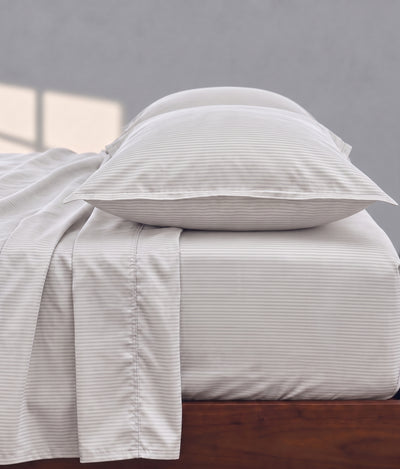
Eucalyptus-derived TENCEL™ lyocell is a fiber GOTS can't certify, so the finished-product test is the one that counts. The Breeze Sheet Set carries OEKO-TEX® STANDARD 100 Class I, the infant-grade tier. |
How Each One Handles Chemical Safety
Both standards care about chemistry; they check it at opposite ends of the production process.
GOTS: Chemical control happens at the input stage.
Dyes and processing agents must come from an approved list, chlorine bleach and certain toxic chemicals are banned outright, and mills have to treat wastewater before discharge, with risk-based residue checks backing it up.
The logic: restrict what goes in, and the output stays clean.
OEKO-TEX®: Chemical control happens at the output.
The finished product is tested in an accredited laboratory against more than 1,000 harmful substances, including formaldehyde, heavy metals, and harmful chemical residues among them, with limit values set by product class.
The logic: whatever went in along the way, verify what's actually in the fabric that touches skin.
Input control and output verification catch different things, which is exactly why the two labels coexist on some products.
Social and Environmental Standards
This is the dimension where the two certifications differ most, and it's worth being direct about.
GOTS: Social criteria are mandatory. Fair wages, safe working conditions, and a prohibition on child labor are built into the standard, aligned with International Labour Organization conventions.
Environmental requirements run through the whole supply chain, from organic farming's reduced pesticide load to factory-level wastewater rules.
For ethical production specifically, GOTS is the framework built to answer it.
OEKO-TEX®: STANDARD 100 doesn't cover labor or environment; it's a product safety test.
The organization addresses factories through its separate STeP certification, but that's a different label.
If working conditions are the question you're asking, that's what STeP is built to answer, not STANDARD 100.
Strictness: Class I vs the 95% Organic Label
Each system has a top tier, and both are printed where you can find them.
On a GOTS product, the label grade itself tells you which tier you're holding: "organic" is the top grade, while "made with organic" signals the lower threshold, so the wording on the tag is the strictness indicator.
On an OEKO-TEX® product, the tier rides with the certificate: Class I means the item cleared the infant-grade bar, where formaldehyde must come back non-detectable and checks the other classes skip, like saliva resistance, get added. A quick lookup of the certificate number confirms which class you're looking at.
If you're comparing tags and wondering which top tier outranks the other, neither does. One is a purity test, the other is a toxicology screen, and they're strict about different things.
Is OEKO-TEX® or GOTS Better? That's the Wrong Question
Plenty of shoppers arrive at this comparison hunting for a winner, and the scorecard above refuses to produce one: two different jobs, each done well by a different tool.
The more useful move is to know your question before you start comparing tags.
-
If your question is how it was made, organically grown fiber, audited factories, fair labor, that's GOTS territory.
-
If your question is what's in it now, the substances sitting in the fabric that spends all night against your skin, that's OEKO-TEX® STANDARD 100, at its strongest in Class I.
-
If a product carries both, and its fiber allows both, you're holding the fullest answer the industry offers.
If bedding is the purchase in front of you, the second question is the one your skin spends all night with, which is why every sheet fabric Buffy makes is certified to OEKO-TEX® STANDARD 100 Class I, the infant-grade tier.
So before your next GOTS or OEKO-TEX® tag-reading moment, settle what you want verified. Decide that, and the right label reads itself.
Frequently Asked Questions (FAQs)
What is the difference between OEKO-TEX® and GOTS certification?
The difference between OEKO-TEX® and GOTS comes down to product versus process. OEKO-TEX® STANDARD 100 lab-tests the finished textile and every component against more than 1,000 harmful substances. GOTS certifies that a product was made from at least 70% organic fibers under environmental and social criteria covering the full supply chain. One verifies what's in the fabric; the other verifies how it was made.
Which certification should I look for when buying safe bedding, OEKO-TEX® or GOTS?
For bedding, look for OEKO-TEX® STANDARD 100 if your priority is knowing the finished sheet tested below defined limits for harmful substances, since that's the test of what actually touches your skin. Look for GOTS if your priority is certified organic fiber and ethical production. Sheets sit against your skin for six to eight hours a night, so the finished-product test is the more direct answer on chemical safety, and Class I is its strictest tier.
OEKO-TEX® Class I vs GOTS: which is stricter for chemical safety?
For chemical limits in the finished product, OEKO-TEX® Class I is the strictest benchmark in textiles: infant-grade limit values, formaldehyde non-detectable, and lab testing of every component. GOTS is strict in a different way, restricting which chemical inputs can be used during processing. GOTS controls what goes in; Class I verifies what came out. For a measured answer about the finished fabric, Class I is the sharper tool.