


Key Takeaways
-
TENCEL™ Lyocell is a plant-derived fiber made from wood pulp, and its moisture behavior is the main reason it sleeps cooler than cotton.
-
Cotton absorbs moisture well but releases it slowly, which is why cotton sheets can turn damp and warm for sweaty sleepers.
-
Softness splits by preference: TENCEL™ reads smooth and cool to the touch, while crisp percale cotton has its own devoted camp.
-
Both fabrics are durable and machine washable, so the deciding factors are temperature, feel, and budget.
-
For night sweats specifically, research links moisture-managing bedding to measurably better sleep quality.
If you wake at 3 a.m. with your sheets stuck to you, the fabric is part of the problem. TENCEL™ Lyocell sleeps cooler than cotton because its fibers pull moisture off your skin instead of holding it there. Cotton, soft as it is, holds that moisture close to the body. That single difference drives most of the TENCEL™ vs. cotton debate, but it isn't the whole story.
Cotton has centuries of loyalty behind it, a crispness many sleepers refuse to give up, and a price range wide enough for any budget. So the honest comparison runs fabric by fabric and trait by trait, the way you'd actually shop for breathable sheets.
Here's how the two stack up, and which sleeper each one suits.
TENCEL™ vs Cotton Sheets: The Full Comparison
The two fibers start in different places, and their origin stories explain most of the differences.
Cotton grows as a boll on the cotton plant and goes to the loom as a natural fiber, mostly as it came. Its quality is decided by staple length: the longer the fiber, the smoother and stronger the thread.
TENCEL™ Lyocell takes a manufactured route to a plant-based result. It starts as eucalyptus wood pulp, dissolved and re-spun into long, uniform strands in a closed-loop solvent process. That uniformity is the whole trick: where cotton fibers are short, flat, and twisted, TENCEL™ strands come out long and even. This changes how the finished fabric handles air, moisture, and skin.
Both end up as breathable bedding textiles, and the six traits below decide the purchase.
|
Trait |
TENCEL™ Lyocell |
Cotton |
|
Breathability |
High; smooth fibers with strong airflow |
Good, especially in percale weaves |
|
Moisture management |
Absorbs and releases moisture, keeping the surface drier |
Absorbs heavily, dries slowly |
|
Softness & feel |
Smooth, cool to the touch, gentle drape |
Crisp to plush, depending on weave |
|
Best for hot sleepers & night sweats |
The stronger pick |
Fine for dry sleepers |
|
Durability |
Holds strength through repeated washing |
Proven over generations, best in long-staple |
|
Price |
Mid to premium |
Budget to premium, the widest range |
Breathability: Which Fabric Sleeps Cooler?
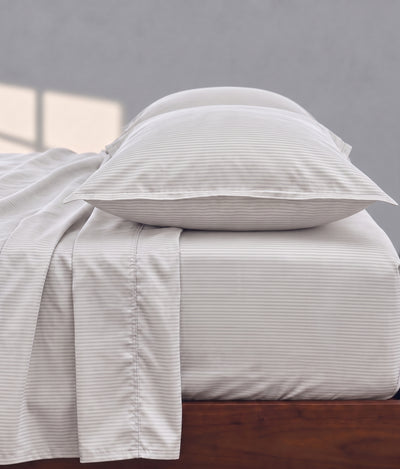
TENCEL™, and the margin is easiest to feel on a warm night. Its smooth fibers let air move freely. Buffy's Breeze sheets test at Qmax 0.224 per FTTS-FA-019 for cool-to-the-touch feel, versus roughly 0.13 for cotton.
Cotton breathes well too, particularly in an open percale weave, and nobody should pretend otherwise; a good percale is genuinely airy.
The separation happens once you start to sweat, because breathability only moves air, and a warm sleeper needs moisture moved as well. That's the next row down. If your only goal is to sleep cooler, the fiber that manages both wins the night.
Moisture: Why Cotton Sheets Can Feel Hot and Sweaty at Night
Cotton is famously absorbent, and that's exactly the problem.
It soaks up what your body releases, then holds it; damp fabric warms to your temperature and stays there. That's the clammy, sticky feeling that wakes warm sleepers at 3 a.m.
TENCEL™ handles the same moisture differently: it absorbs and releases it, supporting a drier microclimate, the layer next to your skin staying dry overnight. That's why Buffy builds its Breeze sheets from eucalyptus-derived TENCEL™ Lyocell.
To be fair to cotton, a dry sleeper may never notice any of this; the gap opens with the sweat.
Softness: Crisp Sheets or Smooth Ones, and What Your Skin Prefers
Softness isn't one scale; it forks into two camps, and most sleepers already know which one they're in.
TENCEL™ feels smooth and fluid, with a surface gentle enough that sensitive skin gravitates toward it, and it stays that way wash after wash.
Cotton runs from hotel-crisp percale to plush sateen and softens with age. The crisp camp is large and loyal for good reason.
Buffy sits in both camps on purpose: Breeze is for smooth sleepers, and long-staple Supima cotton sheets are for anyone who loves a crisp bed.
Softness has no winner, only a preference: smooth and fluid, or crisp.
Night Sweats: What Causes Them, and Can Sheets Actually Help?
Night sweats can come from many sources: a room that's too warm, heavy bedding, hormonal changes, and some medications. Occasionally they signal a condition worth raising with a doctor, especially if they arrive with fever or persist in a cool room.
Sheets can't treat any of those causes, and no honest fabric guide will claim otherwise. What sheets change is how the night feels while your body works.
In one small study of sleepers dealing with severe night sweats, switching to moisture-managing bedding improved overall sleep quality scores by 52%, with easier sleep onset and fewer disturbances.
Fabric is one lever among several, and the rest of how to sleep cooler at night comes from room setup and habits as much as from what's on the bed.
For the fabric lever alone, this row goes to TENCEL™.
Durability: Which Sheets Survive More Wash Days?
Both, if they're well made.
Long-staple cotton has generations of proof behind it and gets softer with age, which is why heirloom linens exist.
TENCEL™ is newer to the textile world but holds its strength through repeated washing, wet or dry, and resists the pilling that shortens a sheet's good years.
So, if you're asking, are TENCEL™ sheets a good long-term buy? Yes. Durability is no longer cotton's private advantage.
For either fabric, the label matters more than the fiber, since weave quality and construction decide how a sheet ages.
A well-made set of either should be a years-long relationship.
Price: What You're Actually Paying For in Each Fabric
Cotton owns the widest range: budget basics, mid-tier sets, organic cotton, and premium long-staple lines all share a shelf. TENCEL™ starts at mid-range and climbs, which reflects the fiber-making behind it.
TENCEL™ costs more up front; the better math is cost per good night.
A fabric that keeps you asleep earns its price back nightly, while a bargain sheet that has you waking damp is expensive in its own way.
Whatever the fiber, buy the best construction you can afford once, because sheets are one of the few purchases you use eight hours a day.
Buy for Your Worst Night, Not Your Average One
On a mild night in October, these two fabrics are nearly interchangeable, and the whole debate feels academic. The separation happens on the bad nights: the heat wave, the stress sweat, the 3 a.m. wake-up with the covers stuck to you.
That's the night your sheets were actually hired for, so choose the fabric that shows up to it.
Hot sleepers and anyone dealing with night sweats should let TENCEL™ take those nights; devoted crisp-sheet sleepers who run dry can keep their cotton with a clear conscience.
Buffy stocks its sheet collection with both fibers for exactly that reason: pick by your hardest night, and every easier one comes included.
Frequently Asked Questions (FAQs)
Is TENCEL™ a natural fiber?
It's plant-based, not natural in the strict sense. TENCEL™ Lyocell starts as wood pulp, so its raw material is plant-grown, but the strands themselves are engineered in a closed-loop solvent process. It belongs to the regenerated-cellulose family alongside modal and viscose. Unlike viscose, TENCEL™ Lyocell is made in a closed-loop process without carbon disulfide.
Are TENCEL™ sheets good for sensitive skin?
Yes, and for two separate reasons. The fiber's surface is smooth and uniform, so it glides where coarser weaves rub, which matters for skin that reacts to friction. And certification covers what's in the fabric: Buffy's TENCEL™ sheets are certified to OEKO-TEX® STANDARD 100 CLASS 1, the certification's strictest tier, meaning the finished fabric was screened against more than 1,000 harmful substances. Reactive skin benefits from both.
Do TENCEL™ sheets shrink in the wash?
Not meaningfully, when washed as the label directs. TENCEL™ holds its shape and strength through repeated washing, and it's less shrink-prone than cotton, which famously tightens up if it meets hot water or a hot dryer. The rule protecting both fabrics is the same: cold water and low or no heat, since heat is what shrinks sheets, whatever fiber they started as.
How do you wash TENCEL™ sheets compared to cotton?
Both machine wash cold water and tumble dry low. No special handling required. Buffy's Breeze sheets, for example, wash cold and tumble dry low, straight from the care label. Skip the fabric softener and bleach, and Breeze stays smooth and wash-and-go.