
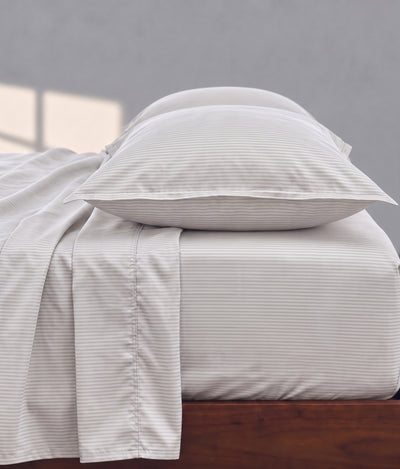


Key Takeaways
-
TENCEL™ lyocell feels cool, smooth, and fluid the moment it hits skin, and the fabric character stays consistent wash after wash.
-
Buffy's Breeze TENCEL™ sheets test at Qmax 0.224 per FTTS-FA-019 for cool-to-touch, compared to standard cotton around 0.13, so it's the pick for hot sleepers.
-
TENCEL™ fiber absorbs about 50% more moisture than cotton and moves it out as vapor 2.5x faster, keeping the sheet surface drier through the night.
-
Buffy's Breeze Sheet Set uses 100% Lenzing TENCEL™ eucalyptus lyocell and carries OEKO-TEX® STANDARD 100 Class I certification, the infant-grade tier.
-
Compared to cotton, TENCEL™ feels smoother and cooler out of the package; long-staple Supima cotton offers a crisp, structured character that many sleepers prefer.
It's 2 a.m. You've kicked off the top sheet, flipped the pillow twice, and your sheets are damp against your shoulder blades.
If that's how a lot of your summer nights end, the fabric on your bed is doing more work than you realize. It's why more hot sleepers are landing on TENCEL™.
So what does TENCEL™ feel like? Cool the second it hits your skin, smooth on the surface, and fluid enough to follow your body's contours through the night.
That sensory profile comes from the lyocell fiber itself, spun from eucalyptus wood pulp in a closed-loop solvent process.
It's why a cooling TENCEL™ sheet set reads the same on night one as it does a year later. The coolest sleep starts with the cleanest chemistry, and TENCEL™ keeps both.
What TENCEL™ Feels Like the First Time You Touch It
Pull a TENCEL™ sheet out of the packaging, and three things register almost immediately: it's cool, it's smooth, and it's light.
Each one comes from a specific property of the lyocell fiber, and each one holds up over years of use because it's structural.
Cool to the Touch
Cool-to-touch is a measurable property of fabric. It's called Qmax, and the number tells you how quickly the fabric conducts heat away from your skin at first contact.
Standard cotton typically tests around Qmax 0.13, which reads as neutral against skin. TENCEL™ lyocell tests notably higher because the fiber has a higher inherent thermal conductivity, which is why a TENCEL sheet registers as immediately cool the moment you get in.
That cool sensation doesn't fade after a few seconds. It's a steady thermal draw that carries through the night because the performance is a property of the fiber itself. There's no coating on the surface to wash out at 10 or 20 cycles.
Smooth Against the Skin
The second thing you notice is the smoothness.
TENCEL™ lyocell fibers are finer than most cottons, and the fabric surface has less microscopic roughness. That translates to lower friction against skin, which matters most for anyone who runs warm, moves around at night, or has skin that reacts to abrasion.
For sensitive skin, that low-friction surface means no scratches on first contact and no pilling in the first few washes.
TENCEL™ sheets show up soft on night one and hold that character through hundreds of cycles because the smoothness is a fiber-level property, not a topical finish.
Fluid Drape, Lightweight
The third thing you notice is how the fabric moves.
TENCEL™ lyocell drapes more like a fluid than a panel. It follows your body's contours, and the fabric shifts with you through the night. The fiber's inherent elasticity helps it recover from compression, so TENCEL™ sheets show fewer deep-wrinkle marks than stiffer fabrics.
A low-heat tumble dry and a prompt fold handle most of the rest. If you prefer crisp, flat bedding, a cool iron on low works without damaging the fiber.
How TENCEL™ Feels Through the Night
First-touch sensory data is one story. What TENCEL™ does over eight hours of sleep is another.
This is where the fiber's moisture handling and thermal consistency start to matter more than the initial contact.
A Dry Surface, Not a Damp Sheet
Cotton absorbs sweat into the weave and stores it there. TENCEL™ lyocell pulls sweat into the fiber core and releases it back into the room as vapor.
The mechanics separate at the fiber level: TENCEL™ fiber absorbs about 50% more moisture than cotton and moves that moisture out as vapor 2.5 times faster.
For a hot sleeper, the practical result is a drier microclimate between skin and fabric.
The sheet surface stays cool and dry through multiple sweat cycles in a single night, which is why TENCEL™ is breathable and absorbent at the same time.
Steady Cool That Doesn't Fade
Many sheets marketed as "cooling" rely on PCM (phase-change material) coatings sprayed onto the fabric after weaving. Those coatings feel cold at first, then fade after 10 to 20 wash cycles.
TENCEL™ works differently.
The cool-to-touch performance is a property of the fiber's structure, so it stays consistent through years of laundering.
That's the difference between science-washed cooling and fiber-based cooling: one has a shelf life, the other holds through years of use.
The Same Feel Wash After Wash
Because the smoothness, cool-to-touch, and moisture handling of TENCEL™ are all structural fiber properties, the fabric character stays consistent through hundreds of wash cycles.
TENCEL™ is durable relative to its weight and softness: machine wash cold, tumble dry low, and skip fabric softener (it coats the fiber and reduces breathability).
That's the full care routine, and it's what keeps the fabric hand consistent from cycle one through cycle 300.
What Makes Buffy's TENCEL™ Breeze Sheet Different
Not all TENCEL™ sheets are made the same. The fiber gives you the sensory baseline, but the finishing chemistry, dye process, and certifications decide whether the fabric that touches your skin is genuinely clean.
Buffy's Breeze Sheet Set is built for both.
OEKO-TEX® STANDARD 100 Class I Certified
The certification worth asking about on any sheet is OEKO-TEX® STANDARD 100 Class I.
That's the infant-grade tier of the program, and it tests the finished textile against more than 1,000 harmful substances.
Formaldehyde comes back non-detectable (<16 mg/kg), heavy metals are locked, and the finished sheet is verified safe for skin contact at the same standard applied to bedding for newborns.
The Breeze Sheet Set carries Class I certification, and every component in the sheet meets the same threshold.
Non-Migratory, Saliva-Tested Dyes
Color in most bedding comes from migratory dyes, meaning the pigment can shift under heat and sweat and transfer to skin.
Buffy's dyes are saliva-tested and non-migratory, so the color stays in the fiber. It doesn't enter your skin or come off on your body under normal sleep conditions.
100% Lenzing TENCEL™ Eucalyptus Lyocell
Buffy uses 100% Lenzing TENCEL™ eucalyptus lyocell, sourced from managed eucalyptus tree plantations and processed through Lenzing's closed-loop solvent system. Over 99% of the solvent used to dissolve the wood pulp is recovered and reused.
The single-fiber construction matters for how the fabric performs.
TENCEL™ blends with cotton or polyester dilute the sensory profile of pure lyocell, and cooling and moisture handling drop with them.
Buffy's Breeze Collection is pure TENCEL™ for the same reason a hot sleeper cares about the fiber in the first place: consistency from unboxing through year three of use.
How Does TENCEL™ Feel Compared to Cotton?
You know what TENCEL™ feels like now. Here's how that reads against cotton on the three dimensions that decide how a sheet feels overnight.
TENCEL™ Feels Cooler From the Moment You Get In
Two fabrics can both be labeled "cool," and the sleeper's experience is genuinely different. TENCEL™ lyocell gives you a cool, ongoing pull. The sheet actively moves heat away from your skin throughout the night, so it keeps you feeling cool as long as your body is producing warmth.
Cotton gives you cool as neutral, sometimes cool-crisp on a percale weave, then it warms with your body as you settle in.
The performance gap shows up in the lab, too. Buffy's Breeze Sheet Set tests at Qmax 0.224 per FTTS-FA-019, well above the standard for cotton.
For a hot sleeper, TENCEL™'s ongoing pull is the deciding difference.
For a cool sleeper or anyone in a colder climate, cotton's tendency to warm up with the body is often exactly what you want.
TENCEL™ Feels Smoother; Cotton Feels Crisper
TENCEL™ lyocell reads smooth from the first touch. The fiber is finer than most cotton, and the fabric surface has less microscopic roughness, so a TENCEL sheet feels close and low-friction against the skin without a slippery edge. The fabric moves with your body.
Cotton, especially long-staple Supima, delivers something structurally different. The hand is crisper and more defined, with a cool, structured character that softens over years of wash cycles into a broken-in feel. Buffy's Supima Cotton Sheet Set is where that classic cotton character lives.
Neither is universally softer. They're two textures with two different fan bases: TENCEL™ for anyone who wants smooth-and-fluid from night one, cotton for anyone who wants structured-and-cool with a broken-in journey.
TENCEL™'s Hand Stays Steady; Cotton Softens Over Time
TENCEL™ arrives at its final feel on night one. The smoothness, cool-to-touch, and drape are structural properties of the lyocell fiber, so there's no break-in period. What you unbox is what you'll be sleeping on a year later.
Cotton follows the opposite arc. It starts crisp and softens with each wash cycle, gaining a broken-in quality that many sleepers actively seek.
If you like watching a sheet earn its character over years of use, that journey of softening is part of the appeal. If you want the same fabric hand from night one forward, TENCEL™ is built for that.
TENCEL™ Feel: The Kind You Stop Noticing
The best bedding does its job quietly. TENCEL™ lyocell fits that description more literally than most fibers.
The cool-to-touch, the smoothness, and the fluid drape you notice on the first night become the fabric's baseline.
You stop registering the sheet as a variable in your sleep, and you start sleeping through it. The reason is fiber structure: the sensory profile is built into the lyocell itself, so laundering doesn't degrade it.
That predictability is why TENCEL™ earns its place in premium bedding, especially for hot sleepers, humid climates, and anyone with sensitive skin.
Buffy's Breeze Sheet Set delivers that TENCEL™ profile alongside chemistry you can trust: 100% Lenzing TENCEL™, OEKO-TEX® STANDARD 100 Class I certification, and saliva-tested non-migratory dyes.
Explore the full Breeze collection to try the fiber for yourself.
Frequently Asked Questions (FAQs)
What does TENCEL™ feel like against the skin?
Cool, smooth, and low-friction. TENCEL™ lyocell registers as immediately cool at first contact (Buffy's Breeze tests at Qmax 0.224 per FTTS-FA-019). The surface has less microscopic roughness than most cottons, and the fiber's fine diameter keeps friction against skin low. For anyone with sensitive skin, that low-friction surface reduces mechanical irritation from movement during sleep.
Is TENCEL™ soft and cool to the touch?
Yes to both. The softness comes from the fine fiber diameter and smooth surface. The cool-to-touch comes from the fiber's inherent thermal conductivity, which tests at Qmax 0.224 per FTTS-FA-019 in Buffy's Breeze Sheet Set, compared to standard cotton around 0.13. Both properties are structural, so they hold up through hundreds of wash cycles.
How does the TENCEL™ hand compare to cotton?
TENCEL™ has a smoother, more fluid hand out of the package. Cotton starts crisper and softens with each wash cycle, developing a broken-in character over years. Long-staple Supima cotton, in particular, has a structured, cool-crisp character that many sleepers prefer. The two are honest alternatives: fluid smoothness on one side, structured crispness on the other. Neither is universally softer.
Does TENCEL™ feel scratchy?
No. TENCEL™ lyocell fibers are finer than most cotton, and the surface has less microscopic roughness, so there's no scratching on first contact. TENCEL™ fabric also doesn't develop pilling in the first few washes, which is a common source of scratchiness in lower-grade cottons or blends. For sensitive skin, TENCEL™ sheets feel consistently soft from night one.