

How to Choose Cooling Sheets for Night Sweats and Menopause Hot Flashes
Bedding cannot stop or treat a hot flash or an underlying cause of night sweats. It can make the bed easier to manage by changing the first-touch feel, how the surface interacts with moisture, how much heat the layers retain and how quickly you can adjust or wash them.
If warmth or sweating wakes you, the most useful bedding setup is not necessarily the one with the strongest cooling adjective. It is the one that matches the part of the night that bothers you, uses evidence for the property being claimed and gives you layers you can change without starting over.
The short answer Choose for your pattern: initial warmth, dampness, heat trapped by layers, alternating hot and chilled feelings, or a partner who sleeps at a different temperature. Then build an adjustable bed around that pattern. No sheet can diagnose the cause or guarantee a symptom-free night.
First, separate sleeping hot from night sweats
A room, mattress protector or heavy bedding can make almost anyone sweat. Health guidance uses 'night sweats' more specifically for repeated heavy sweating during sleep that can soak sleepwear or bedding even when the room is cool. Night sweats can have several causes, including menopause, medicines and other health conditions.
During menopause, hot flashes that happen during sleep are commonly called night sweats. They can bring sudden warmth and sweating, followed sometimes by chills, and they may interrupt sleep. That symptom context matters because a fabric can change the bed around an episode, but it cannot prevent the episode itself.
Health note If night sweats are new, regular, unexplained, soaking, worrying or repeatedly disruptive, talk with a healthcare professional. Bedding guidance is not a substitute for evaluating the cause.
Start with what actually wakes you
Choose the row that sounds most like your night. It tells you where to focus before comparing fabrics or products.
|
What you notice |
What to change or evaluate first |
|---|---|
|
The bed feels warm immediately |
Look for clearly scoped initial-contact evidence and choose a surface feel you enjoy. |
|
You wake damp after an episode |
Separate moisture uptake, liquid movement and drying claims; then prioritize easy laundering and a spare layer. |
|
Warmth builds under the covers |
Reduce unnecessary insulation and examine the mattress protector, top layer and room conditions. |
|
You alternate between hot and chilled |
Use lighter, removable layers that can be adjusted without rebuilding the whole bed. |
|
Your partner sleeps at a different temperature |
Agree on a shared sheet feel, then personalize blankets or top layers on each side. |
What cooling sheets can - and cannot - do
They can change the first-touch sensation
Some fabrics transfer heat away from the skin faster at the first moment of contact. That can make getting into bed feel cooler. The relevant evidence is a defined contact heat-transfer test, such as Qmax. It does not tell you whether the bed stays cool hours later.
They can interact differently with moisture
Moisture uptake, liquid movement and drying are related but different. A moisture-regain value describes how much moisture a fiber holds under stated conditions. A wicking test examines liquid movement. A drying test measures moisture loss over time. One result should not be used as proof of all three - or as proof that a sleeper will sweat less.
They can change one layer of the sleep system
A sheet can be light or dense, smooth or textured, and more or less insulating. But the protector below it and the duvet or blanket above it also shape the temperature and humidity around the body. A sheet cannot correct a warm room or a heavily insulated bed by itself.
They cannot treat the cause
Cooling bedding is a comfort choice. It is not a treatment for menopause symptoms, medication effects, infection, a sleep disorder or another cause of night sweats. Avoid any product claim that turns a fabric measurement into a medical outcome.
Match the evidence to the discomfort
A useful claim names the outcome, sample, method, result and limitation. If a brand does not say what was measured, a cooling adjective cannot tell you whether the claim applies to first touch, moisture, airflow or a complete night in bed.
|
If the problem is... |
Evidence to look for |
Important limit |
|---|---|---|
|
Warm first contact |
Qmax or another defined contact heat-transfer test |
Initial sensation only; not an all-night cooling result |
|
Humidity or dampness |
Clearly named moisture-regain, wicking and/or drying methods |
These are different properties and cannot be substituted for one another |
|
Heat building under layers |
Finished-fabric construction and, where available, air-permeability evidence |
A sheet result does not measure the full mattress-protector-duvet system |
|
Frequent laundering |
Exact care instructions and product-specific durability evidence |
Correct care supports condition; it does not guarantee cooling performance |
For the complete explanation of contact cooling, airflow, moisture behavior and test scope, continue to How Cooling Sheets Work. For broader category shopping, use the Cooling Sheets Guide. Those pages own the technical and category questions so this guide can stay focused on the night-sweats and hot-flashes use case.
A bounded Breeze example
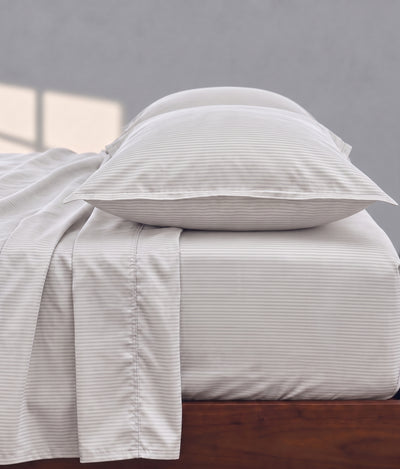
The Breeze Sheet Set provides an example of how to read evidence without turning it into a treatment claim. Breeze is woven from 100% TENCEL™ Lyocell and is also available as a standalone Breeze Fitted Sheet.
Initial contact
In Intertek testing under FTTS-FA-019, finished Breeze fabric achieved a Qmax of 0.405 W/cm². A higher Qmax indicates faster initial heat transfer from skin to fabric under the test setup. This supports a cool-to-the-touch description at first contact. It does not show that Breeze prevents a hot flash, reduces sweating or stays cool for an entire night.
Moisture behavior
In peer-reviewed fiber testing at 20°C and 60% relative humidity, lyocell measured 9.23% equilibrium moisture regain versus 5.54% for cotton - approximately 67% higher. This describes how much moisture the tested fibers hold under the stated conditions. It was not a test of a finished Breeze Sheet Set and does not mean Breeze is 67% cooler, drier or more effective for night sweats.
How to use this example Breeze is an evidence-backed option to consider if you value a smooth, drapey surface and measured initial cool touch. The tests explain defined material properties. Your room, mattress, protector, top layers and personal experience still determine how the complete bed feels.
See Buffy's published test results for the methods, numbers and stated limitations behind this example.
Build a bed you can adjust during the night
Health authorities commonly recommend a cooler room, a fan and bedding that can be layered and adjusted for nighttime hot flashes. The practical goal is flexibility: reduce unnecessary insulation and make it easy to remove or restore warmth as your body feels hotter or cooler.
-
Use lighter, removable top layers. Two light layers are easier to adjust than one heavy comforter.
-
Check the protector. A thick, padded or waterproof layer can change heat and moisture at the mattress surface.
-
Keep air moving. Use a fan, air conditioning or an open window when appropriate for your room and climate.
-
Choose sleepwear deliberately. Lightweight, removable sleepwear adds another adjustable layer.
-
Personalize each side. Partners can share the same sheet while using different blankets or top layers.
-
Change one variable at a time. This makes it easier to tell whether the sheet, protector, top layer or room adjustment helped comfort.
If you are deciding among Buffy sheet families, Best Sheets for Hot Sleepers compares the smooth Breeze path with the textured Belgian Linen and crisp Supima Cotton paths without presenting one material as universally best.
Plan for care after a sweaty night
When laundering is frequent, exact product care matters as much as a cooling label. Follow the sewn label and the instructions for the specific sheet rather than applying one routine to every fabric. Wash and dry the sheet completely before remaking the bed, and consider keeping a spare fitted sheet if quick changes are useful to you.
Correct care supports fit, feel and fabric condition; it should not be described as restoring or guaranteeing cooling performance. Use How to Wash Cooling Sheets and Reduce Pilling for product-specific washing, drying and pilling guidance.
Frequently asked questions
Do cooling sheets stop night sweats or menopause hot flashes?
No. Sheets may change surface feel, moisture interaction and the amount of insulation in the bed, but they do not prevent or treat the underlying episode or condition.
What sheet material is best for night sweats?
There is no universal winner based on fiber name alone. Start with the discomfort you want to manage, then compare finished-product construction, clearly scoped evidence, feel, care and the rest of your bedding.
Why can the bed feel cool at first but warm again after a hot flash or night-sweat episode?
Initial contact and all-night comfort are different questions. Heat can later build beneath a protector or top layer, room humidity can rise, and the fabric can interact with moisture differently over time. A first-touch test does not measure all of those conditions.
What if I feel chilled after sweating?
Use light, removable layers that can be added back without trapping excessive warmth at the start of the night. The goal is adjustability, not the coldest possible bed.
Do I need to replace the full sheet set?
Not necessarily. If you want to change only the surface against the mattress, a standalone fitted sheet may be enough. Compare the Breeze Sheet Set and Breeze Fitted Sheet, then confirm size, pocket depth, contents and current availability on the selected product page.
When should I speak with a healthcare professional?
Seek medical guidance when night sweats are regular, unexplained, soaking, worrying, repeatedly interrupt sleep or occur with other symptoms. A healthcare professional can help determine whether menopause or another cause should be evaluated.
Choose for comfort, then keep the claim honest
A useful cooling-sheet decision starts with the problem you actually experience: first-touch warmth, dampness, trapped heat, difficult laundering or a bed that is hard to adjust. Match evidence to that problem, simplify the layers around the sheet and keep medical questions with a healthcare professional.
To continue, use the Cooling Sheets Guide for the full decision framework, compare Buffy sheets for hot sleepers, review how cooling-sheet tests work, or see the cooling-sheet care guide. If Breeze fits your priorities, compare the Breeze Sheet Set and standalone Breeze Fitted Sheet using the current product details.
Sources and evidence
The health sources define symptoms and support the room-and-layering guidance. The product and research sources support only the specific material statements and measurements attributed to them.
2. Hot Flashes and Night Sweats - The Menopause Society.
3. Hot Flashes: What Can I Do? - National Institute on Aging.
4. Sleep Health and Disorders - American College of Obstetricians and Gynecologists.
5. A kinetic study of moisture sorption and desorption on lyocell fibers - Carbohydrate Polymers.
6. Our Test Results - Buffy.
7. Breeze Sheet Set - Buffy.
8. Breeze Fitted Sheet - Buffy